Wednesday, November 15, 2006

US Dist Ct Dismisses DRA Challenge
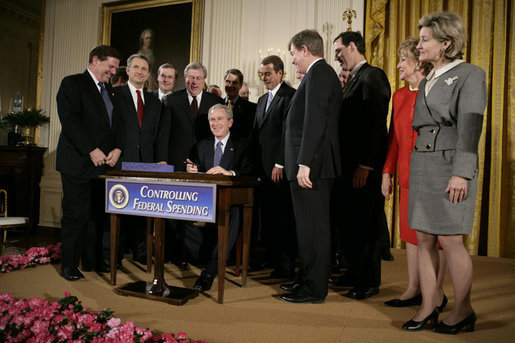

On November 6, 2006, a United States District Court Court, sitting in the Eastern District of Michigan, per Judge Nancy G. Edmunds, dismissed a challenge previously filed by eleven Congressional Representatives to enactment into federal law of the Deficit Reduction Act of 2005. The decision & opinion in the case, Conyers v. Bush, is found here.

The DRA significantly changed rules governing the treatment of transfers of assets & interests in homes by nursing home residents later seeking Medicaid benefits. The implementation of these changes will proceed state-by-state over the next few years. The DRA is generally described in Wikipedia here.
The Bush Administration's explanation of the DRA, generally, is found here.

These are the facts giving rise to the constitutional challenge of the DRA in federal courts. On December 19, 2005, the House of Representatives passed a conference report on S. 1932, the Deficit Reduction Act of 2005, by a vote of 212-206. On December 21, 2005, the Senate passed the conference report by a vote of 51-50. Because the Senate made a minor change in the conference report, it was returned to the House for its approval. But thereafter, the House did not approve the exact same bill as the Senate. The President then signed a bill into law.

In their lawsuit, the plaintiffs claimed that the
Deficit Reduction Act of 2005, Pub. L. No. 109-171, § 10001, 120 Stat. 4, § 183, was invalid and did not comply with Article I, Section 7, of the U.S. Constitution. They claimed that the DRA did not pass the House in the same form passed by the Senate, and that the bill signed by the President therefore could not become law.

More specifically, those Representatives argued that
Section 5101 of the DRA conflicted as follows:

  • The bill, as passed by the Senate, set the duration of Medicare payments to rent certain durable medical equipment at 13 months
  • The bill, as as passed by the House, set the duration of rent payments at 36 months
The Defendants (including the President), who were represented by the United States Justice Department, argued that the Plaintiffs lacked legal "standing" to sue; and the Court agreed. The Judge noted that the United States District Court for the Southern District of New York also recently addressed "standing" in a case that raised the same constitutional arguments against the DRA, in OneSimpleLoan v. U.S. Sec’y of Educ., 2006 WL 1596768 (S.D.N.Y. June 9, 2006).

That district court found no such standing for the plaintiffs to sue. This Court followed that ruling's reasoning, and found that the "Plaintiffs here lack standing because they cannot show that their votes were sufficient to defeat a bill with the 13 month provision."


The Court further ruled that,
even if the Plaintiffs did have standing, the Court agreed with Defendants that their claims were subject to dismissal on a summary basis, without further hearing. The Court reviewed other, almost identical challenges filed in federal courts to the DRA:
The basic facts alleged in Plaintiffs' complaint concerning how the Deficit Reduction Act was passed have been observed by a number of courts addressing the same or similar concerns that Plaintiffs raise here. See Public Citizen v. Clerk, United States District Court for the District of Columbia, ___ F. Supp. 2d ___, 2006 WL 2329329, *2 (D. D.C. Aug. 11, 2006); Cal. Dep't of Soc. Servs. v. Leavitt, 444 F. Supp. 2d 1088, 1096 (E.D. Cal. 2006); OneSimpleLoan v. U.S. Sec'y of Educ., No. 06 Civ. 2979 (RMB), 2006 WL 1596768, *4 (S.D. N.Y. June 9, 2006).

Each of the courts that have addressed the identical issue presented here have held that enrolled bill rule announced in
Marshall Field still applies today. Thus a claim of unconstitutionality for violation of Article I, Section 7, "is not legally cognizable where an enrolled bill has been signed by the presiding officers of the House and Senate as well as the President. . . ." Public Citizen, __ F. Supp. 2d at __, 2006 WL 2329329 at **4, 16.
For these reasons, the Court granted a motion to dismiss. As a result, the DRA still remains enforceable federal law, unless the trial court's action would be overturned by federal appellate courts.

* * *

Update: 02/12/07:

For an excellent update on the litigation in the federal courts derived from the DRA's manner of enactment by Congress, see:
"The DRA One Year Later: Dems Waiting for Outcome of Legal Challenges to Law That Stiffens Medicaid Transfer Penalties", dated February 10, 2007. Here is an excerpt:

So far, federal district courts have rejected five challenges to the DRA's legitimacy, including ones by Public Citizen and by Rep. John Conyers (D-MI) and ten other members of the House of Representatives.

While these cases remain on appeal to federal circuit courts, a sixth challenge brought by ElderLawAnswers member attorney Jim Zeigler in federal district court for the Southern District of Alabama is still pending. (See Elder Law Attorney Sues Over New 'Law' Affecting Medicaid Transfers" .) Zeigler says his suit has a better chance of succeeding than the others because of support from an unexpected source.

Tuesday, November 14, 2006

PBI's 2006 "Estate Law Institute"


The 13th Annual "Estate Law Institute", sponsored by the Pennsylvania Bar Institute, will be offered in Philadelphia on Wednesday, November 15, and Thursday, November 16, 2006, at the Pennsylvania Convention Center, located at 12th & Arch Streets, from 8:30 to 4:45 pm each day.

The Institute is described by PBI as follows:


Every year, more than 400 of Pennsylvania’s finest estate lawyers attend the Estate Law Institute and think it is the best way to remain informed in the changing world of an estate practice. Join your colleagues at our "custom" program with sophisticated tracks discussing issues that arise with high-net-worth clients, as well as overviews of both planning and administration topics, perfect for those entering the field.

Take advantage of walking through our extensive exhibit area where you will find a variety of products and services that can enhance your estate practice.

A wide range of updates ensures that the general practitioner, as well as those specializing in estate practice, stays up-to-the-minute on all the latest issues and strategies.


The list of topics during the two-day Institute will include (but certainly not be limited to):

  • New Pennsylvania Uniform Trust Act
  • Act 43 & Deficit Reduction Act Issues
  • Changing Face of Estate Practice
  • Keeping the Business in the Family
  • Federal Estate & Gift Taxation
  • Orphans' Court Rules Update
  • Probate & Estate Distribution Issues
  • Asset Protection Planning
Registration begins at 7:45 am each day. Further information can be obtained online here.

Monday, November 13, 2006

NPR on the "Doughnut Hole" in Medicare Rx Coverage

On Monday morning, November 13, 2006, during its "Morning Edition" radio show, National Public Radio broadcast a report entitled "Seniors Struggle over Medicare Drug Gap Coverage", by Joanne Silberner, regarding the significant cost exposure by Medicare recipients for prescription medications under the provisions that took effect in 2006. You can read and hear the NPR story here.

The article recites individual seniors' situations where the costs of their medications increased after the initial Medicare drug coverage was exhausted, but before their further personal deductible payment was achieved. This is the so-called "doughnut hole" in Medicare coverage.


This problem was revealed in 2004, after the adoption of the new Medicare Prescription Drug Program. For example, see an article
entitled "Report Warns of Medicare Drug Coverage Gaps -- 2006 Benefit Could Anger Seniors Expecting More Help With Drug Costs, Analyst Says", by Todd Zwillich, which appeared here on June 1, 2004, as posted on WebMD:

Medicare began its controversial prescription-drug discount plan today, although some analysts are already looking ahead to 2006 when the program's paid drug benefit begins. And some are warning that many seniors may find far lower benefits than they expect.

A new report issued Tuesday warns that substantial numbers of elderly and disabled Medicare beneficiaries can expect high drug expenses even after the program begins in 19 months. Some, especially those with more than one chronic illness requiring medication, may still incur thousands of dollars in out-of-pocket costs, it concludes.

A CBS Evening News story broadcast nationally on July 26, 2006, entitled "Medicare's 'Doughnut Hole'
-- Millions Of Seniors Are Hitting A Gap Where They Pay All Drug Costs", found here, explained the problem:

Medicare Part D is providing prescription drug coverage to millions of older Americans. But ever since the program went into effect in January, there's been an epidemic of confusion and headaches. As CBS News correspondent Wyatt Andrews reports, here comes another one: the "doughnut hole." * * *

The problem is . . . a gap in coverage called the "doughnut hole" — in which seniors pay for all of their drugs themselves. * * *

For all patients, Medicare covers 75 percent of the first $2,250 worth of drugs. But after that, coverage drops to zero — and doesn't resume until the patient hits $5,100 in expenses. Then Medicare kicks in again, paying 95 percent of costs. But it's this gap — of almost $3,000 — that many sick and disabled seniors call unaffordable.


The CBS Evening News report noted that Medicare officials offered two suggestions for seniors hoping to avoid the "doughnut hole":

  • Switch to lower-cost generics if possible and you won't hit the hole so fast.
  • Also, this November, you can also switch plans: Choose one that might be more expensive but offers coverage in the coverage gap.
The Henry J. Kaiser Family Foundation noted here the potential political effects of the "doughnut hole", which many seniors had eaten into before the General Election.

The
Center for Medicare Advocacy, Inc., offers a detailed explanation, entitled "Calculating the Medicare Part D Donut Hole", found here, as to the "doughnut hole" principles and personal calculations, which can be complex.

The NPR article focuses on Medicare beneficiaries' actual responses to the increased financial exposure now that the initial coverage has been exhausted for them, and offers other tips how to cope.

According to a study by Consumers Union, people usually can find better prices outside their Medicare prescription drug plans.

But there's a good reason not to make that move, according to Pete Sikora, one of the Consumers Union study authors.

"We generally recommend that people shop within their plan, that they don't go outside of the plan," Sikora says.

That's because the drugs have to be purchased through their Medicare plans to count towards the amount needed to restart the coverage.

The NPR article is accompanied by other online resources with information about low-cost drugs or renegotiation of Medicare drug plans, as follows:
For previous NPR reports broadcast about Medicare Prescription Drug benefits, read and hear stories posted as follows:
  • Benefit Gap Surprises Medicare Drug-Plan Participant (July 25, 2006) -- "There's a problem with the new Medicare drug-benefit plan: a gap in coverage. The gap occurs when the cost of prescriptions rises to a certain level. Critics of the plan have been issuing warnings about this gap since before the legislation was signed."
  • Medicare Premiums Set to Rise for All (September 13, 2006) -- "The head of the Medicare program has announced that next year's premiums will increase. And for the first time, richer people will have to pay more than others. Of the 42 million Americans who use Medicare, officials estimate that 1.5 million will face higher premiums because of their income."
Two years ago, The Commonwealth Fund asked the question: "Could senior citizens in the United States receive full prescription drug coverage under Medicare, without causing any increase in Medicare spending?"

Yes, answered a study entitled, "Doughnut Holes and Price Controls" (Health Affairs Web Exclusive, July 21, 2004), conducted by researchers at Johns Hopkins University and Pennsylvania State University, with support from The Commonwealth Fund and the Robert Wood Johnson Foundation.

Seniors could receive full prescription drug coverage, without any "doughnut hole",
if prescription drug prices in the United States were typical of the prices in Canada, United Kingdom, and France. That study is described here.

Sunday, November 12, 2006

PA House to Consider SB 628 on Wed Nov 15th


The leadership of the Pennsylvania House of Representatives has scheduled floor consideration of Senate Bill 628, in its third & final reading of Printer's No. 2117, for next Wednesday, November 15, 2006.

I was so advised by Representative Steve Maitland, who believes that there is support for SB 628, and who advocates for its passage.

I explained and offered support for SB 628 in two prior postings:

If the House adopts SB 628 in the identical form already adopted by the Senate, without any changes or riders, then I estimate that the Governor would sign it into law.

It should be so, because SB 628 would create a much-needed law for the "health & welfare" of all Pennsylvanians -- because we all will face health care decisions and, ultimately, end-of-life medical decisions. SB 628 would provide a structure and process for medical decisions by surrogates, if needed.

The President of the Pennsylvania Bar Association recently sent a letter of support for SB 628 on behalf of that membership. Many other organizations desire its adoption into law, as I reviewed previously.

Now is the time to advocate for SB 628 during this final consideration.

Individual expressions of support should be sent by email to current State Representatives, who are listed here, and to the Governor's Office, through the Governor's Office of Public Liason, which can be contacted as follows:

Office of Public Liaison
508E Main Capitol Building
Harrisburg, PA 17120

Tel: (717) 787-5825
Fax: (717) 772-8284
Email:
publiaison@state.pa.us

UPDATED 11/20/06:

SB 628 was adopted by the House 191-0. See: House Passes SB 628!

Saturday, November 11, 2006

CBS News to Air "Elder Abuse" Series


The National Center on Elder Abuse has provided suggestions and information to CBS News for a two-part series dealing with the growing problem of elder abuse -- whether intentional or through neglect -- in both assisted living facilities and private homes.

Broadcast of the two-part series is now scheduled for early next week.

CBS News has advised NCEA, that, barring breaking news, the pieces about Elder Abuse will air on Monday, November 13, 2006, and Tuesday, November 14, 2006, during network broadcasts of "CBS Evening News with Katie Couric", which will begin at 6:30 PM ET.

More information and related links will be available on the CBS News website,
here.

The news segments could be viewed online from that CBS News website for those unable to catch the live broadcast.

Friday, November 10, 2006

Pennsylvanian Jack Palance Dies


Previously I made a posting, "PA's Jack Palance Sells Personal Items at Auction", about proud Pennsylvania senior citizen Jack Palance, who offered many of his personal possessions for sale on October 12, 2006, at an auction held in Hazelton, PA.

Sadly, on Friday, November 10, 2006, Jack Palance died.

His passing was reported in an article posted on Comcast by the Associated Press here, entitled "Oscar-Winning Actor Jack Palance Dies".

The article begins:

Jack Palance, the craggy-faced menace in "Shane," "Sudden Fear" and other films who turned to comedy at 70 with his Oscar-winning self-parody in "City Slickers," died Friday.

Palance died of natural causes at his home in Montecito, Calif., surrounded by family, said spokesman Dick Guttman. Palance was 85 according to Associated Press records, but his family gave his age as 87. * * *
The article concludes: "Movie audiences, however, were electrified by the actor's chiseled face and hulking presence, and a calm, low voice that made him all the more chilling."

He will be remembered for his brash, tenacious, and iconoclastic approach in a long life. Born in Hazel Township, PA, in 1919, he will remain a famous Pennsylvanian.

Jack Palance: "Do you know what the secret of life is?
One thing. Just one thing.
You stick to that and everything else don't mean shit."


Billy Crystal: "Yeah, but what's that one thing?"

Jack Palance: "That's what you've got to figure out."

-- From the movie City Slickers, as quoted here